

We kept running into the same issue. As teams moved faster, finding the right answers became harder than it should be. Eventually, we built something to remove that friction.
We didn’t plan to build an AI assistant
It started with something small. Someone asked where to find a document. A few replies came in, none completely certain, and eventually someone found it.
Nothing unusual. It happens in every team, ours included. But it kept happening.
The same questions coming up again. The same people getting interrupted. And at the same time, there were people who didn’t ask at all. They just went off and searched. It usually starts simple, then suddenly you’re three folders deep, not even sure if you’ve got the right version.
It’s the kind of thing that’s easy to manage when the team is small.
But once things start moving faster, it shows up everywhere.
It wasn’t a lack of knowledge
We weren’t short on knowledge. If anything, we had plenty of it, and it was already fairly well organised. Documents, onboarding guides, internal processes, knowledge sheets. Most of it was already centralised. But getting to it at the right time was still harder than it should be.
Inside the team, no one really wanted to browse through documents. We just wanted to ask a question and move on.
That’s when we started thinking, what if getting an answer was as simple as asking for it, but still grounded in our own documents?
So we tried something different...
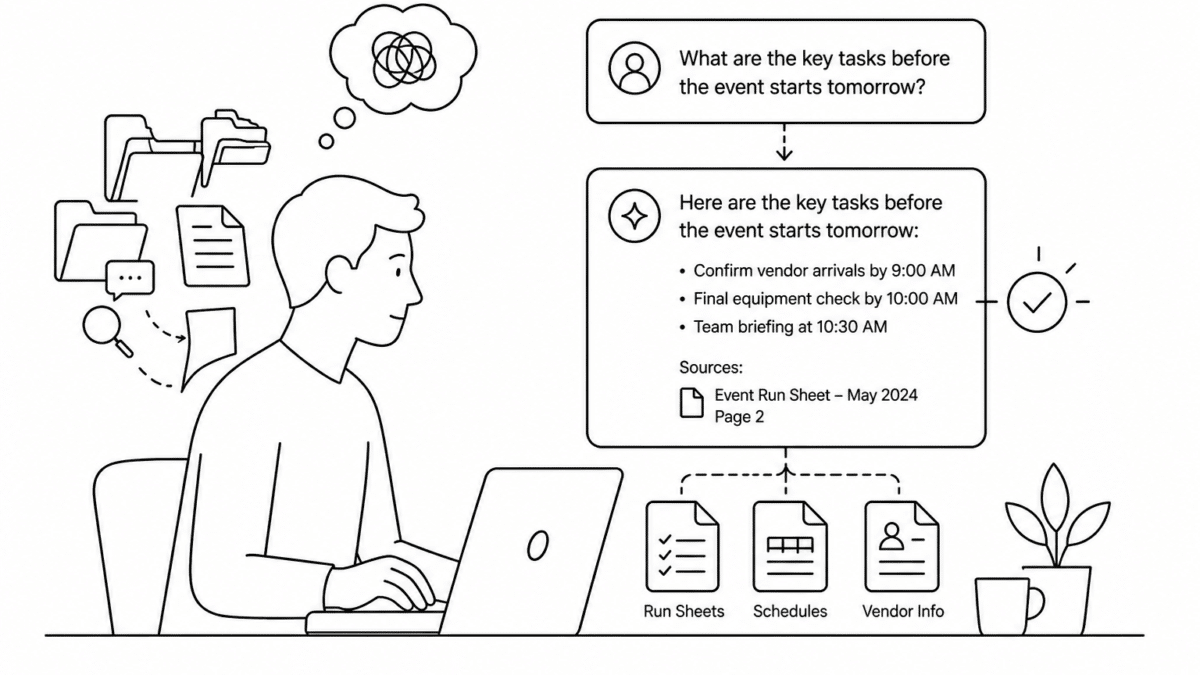
We built something simple that sits on top of the knowledge we already had. Nothing complicated. You ask a question in plain language, and it pulls the answer from the documents that are already there.
Because it’s grounded in your own documents, the answers reflect what’s actually been written and approved, not something generic or outdated. If something changes, you update the document, and the next answer reflects that. There’s no second guessing whether you’re looking at the latest version.
Where this really showed up
One situation where this really stood out was event work. There were run sheets, schedules, vendor details, notes from previous events. Everything documented properly. But when something needed to be confirmed quickly, it still turned into messages going back and forth, or someone digging through folders trying to find the right version.
Especially when timelines are tight and things are changing quickly, no one has time to double check documents or wait for replies.
With this solution, those questions became straightforward. You ask, and the answer comes back from the actual documents. No back and forth, no digging through folders unsure if it’s the right thing.
The difference wasn’t dramatic in a “new system” kind of way. It was more in the day-to-day. Fewer interruptions. Less time spent searching. Things just moved a bit faster. And it didn’t take long to realise this wasn’t unique to us, the busier and more productive the team, the more it showed up.
Juggling admin, strategy, and delivery?
Yoponn helps SMEs break the cycle
Global Access